
I’ve not been in the mood to write since the world seems to be spiralling out of control and societies once known as democracies turning in to facist hot beds, here is looking at you USA. But the commentary of a Dutch nitwit called Kevin under an Instagram post of journalists standing in solidarity with Hunter Hess’ statement about ICE. Kevin wants athletes together with artists, actors, musicians, etc to not talk about politics and do what they are supposed to do, entertain us.
Well, I got news for you Kevin, these people are not dancing monkeys for us. These people are people with opinions that they are free to voice whenever they like even if it does not suit your taste. But Kevin is a moron that only wants to consume entertainment without having to think about things. The boring type of person, in my opinion.
When you think of sports, even that is political especially on the world stage. Countries put out the best of the best in international competitions often displaying pride in their countries traditions and customs. You see it in the openings ceremony of the Olympics where each country shows what makes them a proud athlete representing them. Kudos to this years Winter Olympics participants of Mongolia, now thats how you how you show your culture and big boo to the Olympic Commitee for forcing Hatian participants to change their outfit and disqualifing Ukrainian skeleton racer Vladyslav Heraskevych for having images of dead Ukrainian athletes on his helmet. Remembrance is not a crime and since the Russian invasion 660 Ukrainian athletes have been killed and they want to lift the ban on Russians participating under their own flag. Fuck that organisation.
With all that said now comes my favourite subject, a form which at times can be very political, art. Art has been used in propaganda and art has been used to lash out to society and challenging what is normal. And the likes as Kevin, need to shut up about being confronted with things that force someone to think.
One of my favourite painters of all time, is Artemisia Gentileschi. She was a Baroque painter and considered to be among the most accomplished 17th-century artists. She was producing professional work by the age of 15 and the first woman to become a member of the Accademia di Arte del Disegno in Florence. Her clientele were found all over the world. Damn girl, you are slaying in a time that oppressed women very much. She even worked at the court of Charles I of England. Queen energy for sure.
Many of Gentileschi’s paintings feature women from myths, allegories, and the Bible, including victims, suicides, and warriors. Unfortunately, much of her life and accomplishments were overshadowed by a horrific rape at 18 years old.
In 1611, Orazio was working with fellow painter Agostino Tassi to decorate the vaults of Casino delle Muse inside the Palazzo Pallavicini-Rospigliosi in Rome. Around this time, Orazio had rented the upstairs apartment of their home to a female tenant, Donna Tuzia. Orazio recruited Tuzia to act as a “chaperone” or “guardian” for his daughter, Gentileschi being a younger woman without the guidance of a mother. During this time, Tuzia allowed Tassi and his friend Cosimo Quorli, a minor papal official, to visit Gentileschi in Gentileschi’s home on multiple occasions. Tuzia later testified that Tassi, though initially “devoted” to Gentileschi, grew increasingly obsessed with her.
One day in May, Tassi visited the Gentileschi household and, when alone with Gentileschi, raped her. Quorli, who had himself likely previously attempted to rape her, was also implicated in the assault, accused of acting as Tassi’s accomplice.
Gentileschi later testified that she tried to fight back against Tassi, scratching his face and unsuccessfully attempting to attack him with a knife, and that she cried out to Tuzia for help, which went unanswered. Art historian Jeanne Morgan Zarucchi compared Tuzia’s betrayal and role in facilitating the rape to the role of a procuress who is complicit in the sexual exploitation of a prostitute.
In the aftermath of the assault, Tassi demanded to have further sexual relations with Gentileschi, on the promise that they would marry, thereby restoring her virtue and securing her future. Gentileschi agreed to this arrangement, but Tassi later reneged on the promise to marry her. Unbeknownst to Gentileschi, Tassi was already married, albeit estranged from his wife. Nine months after the rape, when he learned that Gentileschi and Tassi were not going to be married, her father Orazio pressed charges against Tassi.
As was typical of the time, the major issue of the trial was the fact that Tassi had violated the Gentileschi family’s honor, and not the fact that he had violated Gentileschi herself. In the words of history professor Elizabeth S. Cohen: “The law gauged damage to economic and social assets rather than suffering and psychological trauma.”
During the ensuing seven-month trial, it was discovered that Tassi had planned to murder his wife, had engaged in adultery with his sister-in-law, and planned to steal some of Orazio’s paintings. During the trial, Gentileschi was tortured with a “sibille”, cords wrapped around the fingers and pulled tight (similar to thumbscrews), for the purpose of verifying her testimony (a common practice at the time). As the cords tighten, she is recorded as turning to Tassi and saying: “This is the ring that you give me and these are your promises.”
At the end of the trial, Tassi was convicted and sentenced to exile from Rome, although this punishment was never carried out, and he ultimately spent less than a year in prison.
Fuck that man Tassi, what an asshole with his little weasel Quorli. But my girl Artemisia didn’t keep this horrific event inside, she painted the pain, anger and disgust on the canvas and her art made men feel very uncomfortable.
Let me take you on a wonderful trip down her very famous works in which she slays literally and figuratively.
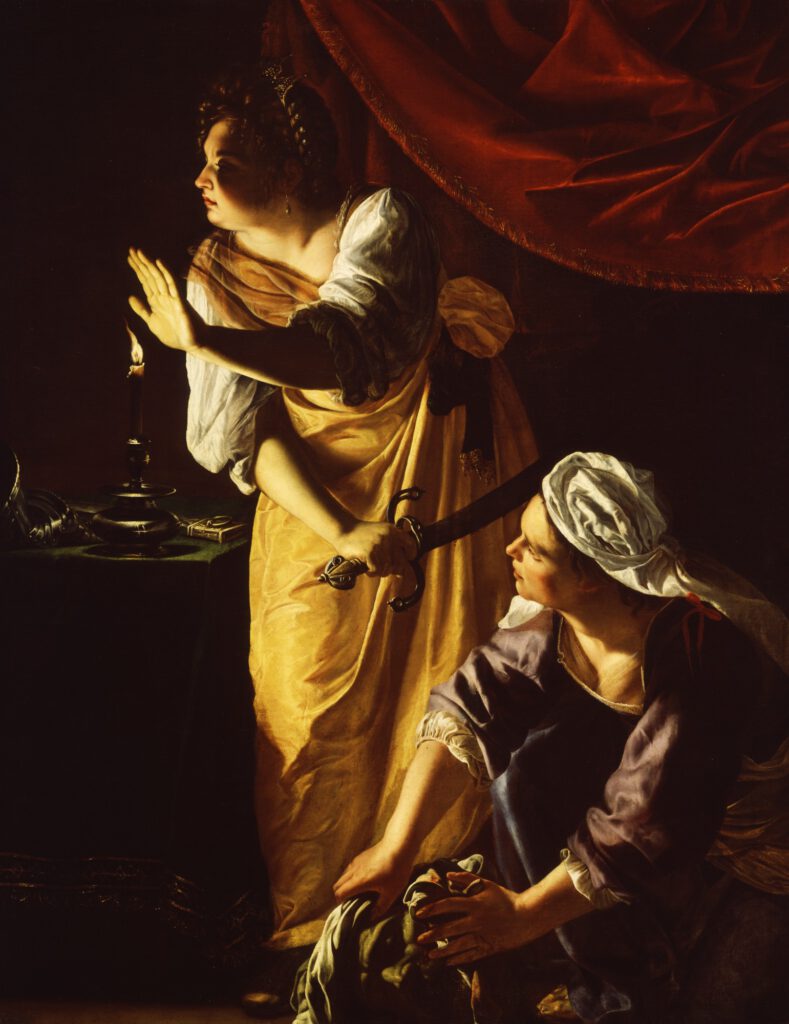
Judith and Her Maidservant is one of four paintings by the Italian baroque artist Artemisia Gentileschi that depicts the biblical story of Judith and Holofernes. This particular work, executed in about 1623 to 1625, now hangs in the Detroit Institute of Arts. The narrative is taken from the deuterocanonical Book of Judith, in which Judith seduces and then murders the general Holofernes. This precise moment illustrates the maidservant Abra wrapping the severed head in a bag, moments after the murder, while Judith keeps watch. The other three paintings are now shown in the Museo di Capodimonte in Naples, the Palazzo Pitti in Florence, and the Musée de la Castre in Cannes.
The explicit nature of the artist’s interpretation has led writers to believe that there is a deeper meaning behind Artemisia’s Judith, drawing back to the rape trial against Agostino Tassi.
Speculation from Elizabeth Cropper asserts that Gentileschi painted the feminine figures in a more heroic lighting, attributing characteristics of tragedy and sadness to these women, while also justifying their actions from an ethical standpoint. This representation of women in positions of power communicated Gentileschi’s endorsement of female strength and potential. To the knowledge of historians, Gentileschi’s patrons were all male. According to a string of Venetian poems that were sent to Gentileschi in 1627, those that followed the artist and purchased her work did so because she was female. Even though her figures were painted in the nude, contemporary critics expressed that there was more of a sensual wonder related to her womanly traits as an artist.
After practicing and honing her artistic abilities for only three years, Gentileschi’s father Orazio described his daughter’s talent as having superseded the level of the masters. Others who were very close to her, like academician Joachim von Sandrart, commended her work from which exuded “knowledge and rationality”, traits that were not normally connected to women of the time.
And I get it, as a sexual assault survivor myself, often the perpetrators get away fully or get away with light punishment because women’s stories or not believed or downplayed too much. Heck, there was a time when I tried to report it that the police adviced against pressing charges because it is a “she said, he said story”. So I have been ACAB for 27 years now, because fuck those guys.
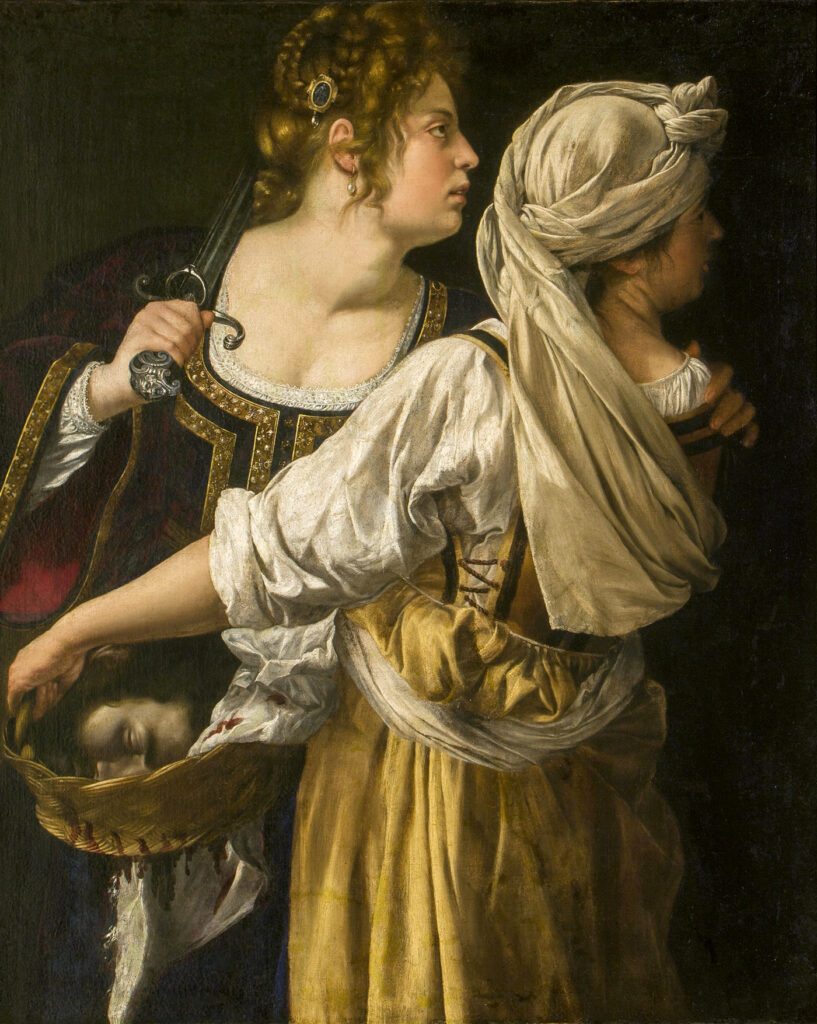
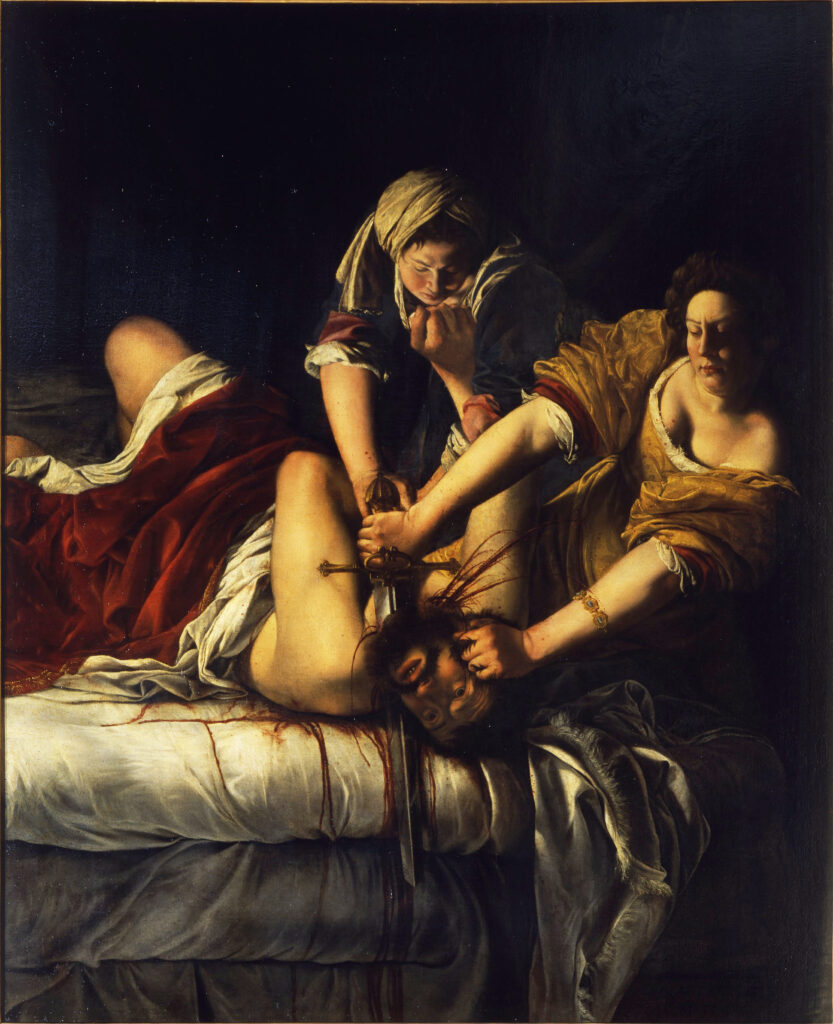
One of her best works can be seen in Florence, Judith Beheading Holofernes. Gentileschi centers her work on the labor of the killing, which forces the gaze to start amid the tangle of blood, limbs, and metal. Her ability to display brutal realism is shown particularly in the details, such as the arc of carotid blood that spatters across the frame. This scene displays the use of chiaroscuro, or the drastic contrast between light and dark, both literally and figuratively.
Holofernes struggles in vain to press against Abra as the two women force him down with distinctly strong arms. Their sleeves are rolled up, as though they are performing an unavoidable domestic chore, and their faces express a staunch resolve. Judith drives the sword, which is noticeably vertical and shaped in a way that alludes to a cross, into flesh with an exertive force. Abra is depicted as almost a mirror to Judith, with a youthful appearance that departs from earlier portrayals of her character. She holds firm to the left arm of their victim as he pushes against her breast in desperation. Holofernes, whose blood puddles and spurts a deep red to contrast the white sheets of his deathbed, is overpowered and without hope.
How I wished I could have done this to my abusers, because the Law didn’t punish them at all or enough for what they did to me. I have a life sentence and they won’t even remember me. And boohoo to the people who say I should not have these feelings of violence towards my perpetrators while they had absolutely no remorse to commit an act of violence towards me. They are luckily if they never run into me again.
In a world where metoo is becoming louder, where people of power have been getting away to long with committing perversions on women young and old, looking at these art pieces gives us empowerment. Throughout history women haven’t been quiet about the injustices that have been done on them. I am tired of us being pictured as the weepy fragile woman that needs saving. I applaud strong women that are out there in the media giving young girls hope like Simone Biles, Harriet Tubman, Rosa Parks, Francesca Albanese, Malala Yousafzai, Marie Curie, Aletta Jacobs, Lupita Nyong’o, Michelle Yeoh. But even fictional women give us the voice that we need to fight against the patriarchy like Ellen Ripley, Susan Sto Helit, Sarah Connor, Princess Leia, Xena, Naru, Aloy, Hazel Flood, Maeve Millay,
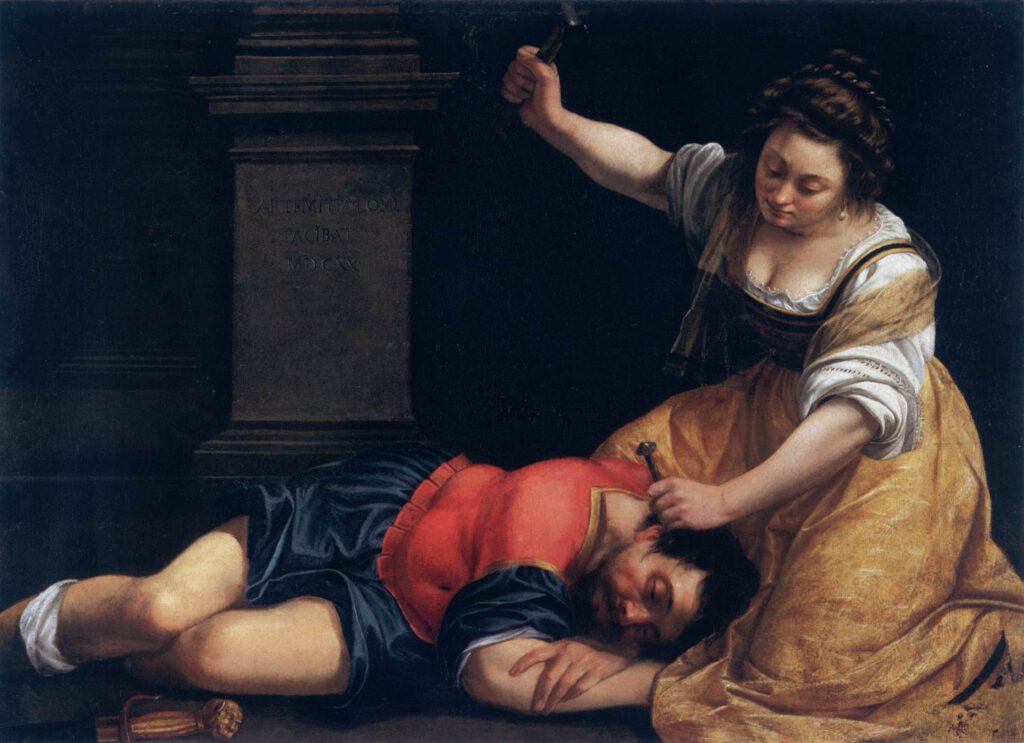
Women won’t let themselves be silent and sometimes you just need to whack a nail in someone’s head because he won’t listen anyway to our stories.
This has been written by a human being, fuck AI, with excerpts from Wikipedia.